The Night a Crowd of 55,000 Turned a Beatles Concert Into History
Fifty-five thousand six hundred voices rose at once, rolling across the open air in Queens, New York, like a living wave. The stage sat small and rectangular in the middle of a baseball field, dwarfed by the concrete bowl surrounding it. Police lined the grass. Helicopters circled above. And somewhere in the middle of it all stood four young men in matching suits, holding instruments they could barely hear.
When The Beatles stepped onto that stage, rock music changed forever.
This was the first major outdoor stadium concert in history. Before that night, bands played theaters, ballrooms, and arenas. Rock lived indoors. But Shea Stadium cracked the ceiling off the genre. Tickets ranged from $4.50 to $5.75 and sold out in less than three weeks. The show grossed a record-breaking $304,000, with over $160,000 going directly to the band, numbers unheard of at the time.

Yet statistics only tell part of the story.
What defined Shea Stadium was not the money. It was the noise.
The screaming started before the first chord of “Twist and Shout” had a chance to land. Girls cried. Fans fainted. Some clutched each other just to stay upright. The sheer volume swallowed the amplifiers whole. The Beatles’ Vox amps were built for small venues, not a sea of humanity. There was no modern stadium PA system. The band could barely hear themselves, let alone each other.
Ringo Starr would later say he relied on watching the others move to keep time. If John’s shoulder shifted or Paul’s head turned, that was his cue. They weren’t just performing songs. They were navigating a storm.

The setlist moved quickly, “I Feel Fine,” “Ticket to Ride,” “Can’t Buy Me Love,” “Help!”, hits delivered into the wind of hysteria. From the stands, most fans heard more screaming than music. But it didn’t matter. The event itself was the performance.
Visually, it was overwhelming. The tiny stage in the center of a massive baseball field. The band arriving by helicopter like visiting dignitaries. Television cameras capturing the frenzy. Everywhere you looked, youth surged forward, united by something electric and unstoppable.
This wasn’t just fandom. It was identity.
In 1965, America was changing. Culture was shifting. And The Beatles stood at the center of it all, not as distant icons, but as four young men trying to play through the loudest moment of their lives.
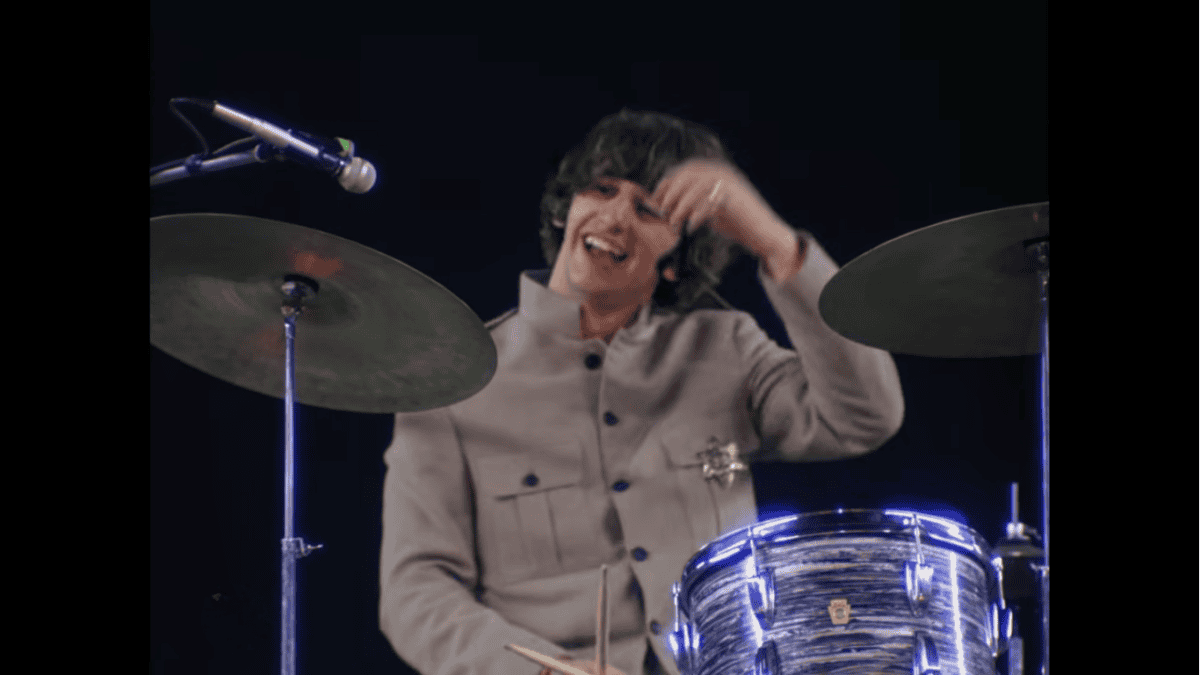
There is something almost poetic about the irony of that night. The band played with precision and energy, but their music was drowned out by the very devotion they inspired. Musically, the show was chaotic. Culturally, it was seismic.
Every massive stadium tour that followed, from Springsteen to U2 to Taylor Swift, traces its roots back to Shea. The blueprint for modern stadium rock was born in that deafening summer air. The scale. The logistics. The spectacle. It all started here.
But Shea Stadium also hinted at something else.
It showed The Beatles how large their fame had become, and how difficult it would be to control. Within a year, they would stop touring altogether. The noise had grown too loud. The machine too big.
Still, on that August night, none of that was certain. There were only four silhouettes against the floodlights and a crowd that seemed to shake the sky itself.
They couldn’t hear their own music.
But the world heard the shift.
Shea Stadium wasn’t just a concert. It was the moment rock music stepped into the open air and realized how powerful it had become. And in the middle of it all stood The Beatles, smiling, strumming, surviving, as the sound of a generation rose louder than any amplifier ever could.