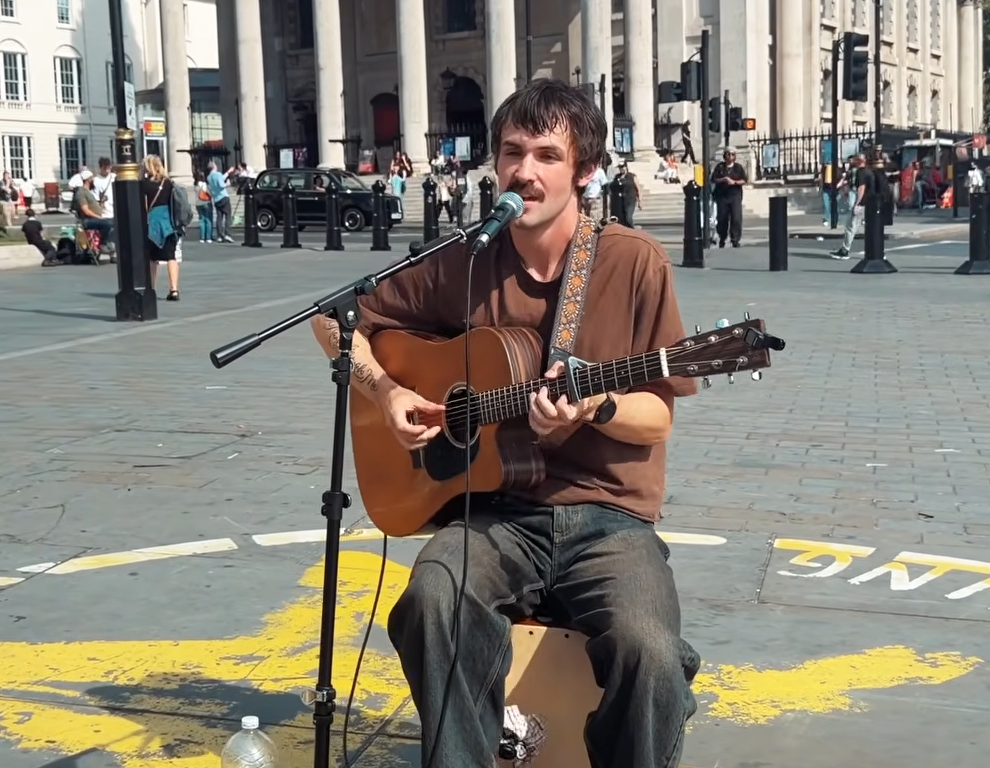
A Group of Friends Starts Playing “Jolene” in London, and the Crowd Loves It
Atticus Blue and a group of friends turn Dolly Parton’s Jolene into a full street-band performance in front of London’s National Gallery. Guitar, mandolin, keyboard, upright bass, cajón, and several voices fill the square while a crowd gathers around them.
What begins as a country classic becomes a warm, lively collaboration between friends playing right in the middle of the city.
The lineup immediately makes this version feel different.
Mandolin, acoustic guitar, keyboard, upright bass, and cajón give the song a fuller, more colorful sound, while several voices move in and out of the arrangement. Instead of centering everything on one singer, the group lets the performance feel shared from the start.
That works especially well in the middle of Trafalgar Square. The musicians are surrounded by passersby and a growing crowd, yet the arrangement still feels relaxed rather than oversized.
The familiar chorus remains the anchor, but the pleasure comes from hearing all those parts come together around it. Each instrument adds something different, and the voices give the performance a warm, communal feel.
The group’s affection for Dolly Parton is an important part of the story.
They are not choosing Jolene simply because everyone knows it. The song comes from an artist they admire, and that shared respect gives the performance a little more purpose.
You can feel that in the way the band approaches it. Nobody tries to turn the cover into a flashy reinvention. They keep the melody recognizable, let the arrangement breathe, and allow the group dynamic to carry the moment.
That makes the performance feel more like friends celebrating a favorite songwriter than musicians trying to outdo the original.
Atticus Blue’s connection to Jolene goes beyond this street collaboration.
In his own Jolene tribute, he speaks warmly about Dolly Parton’s songwriting and the influence she has had on independent musicians and songwriters.
That background adds something to his role here. He is not simply joining another familiar cover. He is returning to a song he already values, this time surrounded by a larger group of musicians and a live crowd.
Dolly Parton first released Jolene in 1973, and the song has since become one of the most covered titles in her catalog. This version keeps its country roots visible while opening the arrangement up through mandolin, upright bass, keyboard, percussion, and several voices.
By the final chorus, the performance has gathered plenty of momentum.
The group stays with the refrain, the band keeps the arrangement moving, and the crowd remains gathered close around them. In a setting this public, that attention matters. People could keep walking, but plenty choose to stay.
When the song ends, applause rises around the musicians, followed by a quick, grateful thank-you.
It is a simple ending, but it suits the performance. A group of friends takes one of Dolly Parton’s best-known songs, fills a London square with it, and lets the crowd share the moment from only a few feet away.
Anyone who would like to see more from Leire can follow her on Facebook or subscribe to her YouTube channel.