Under Soft Lights, She Whispered a Hit Into Magic: Sabrina Carpenter’s Intimate ‘Espresso’ Live Moment
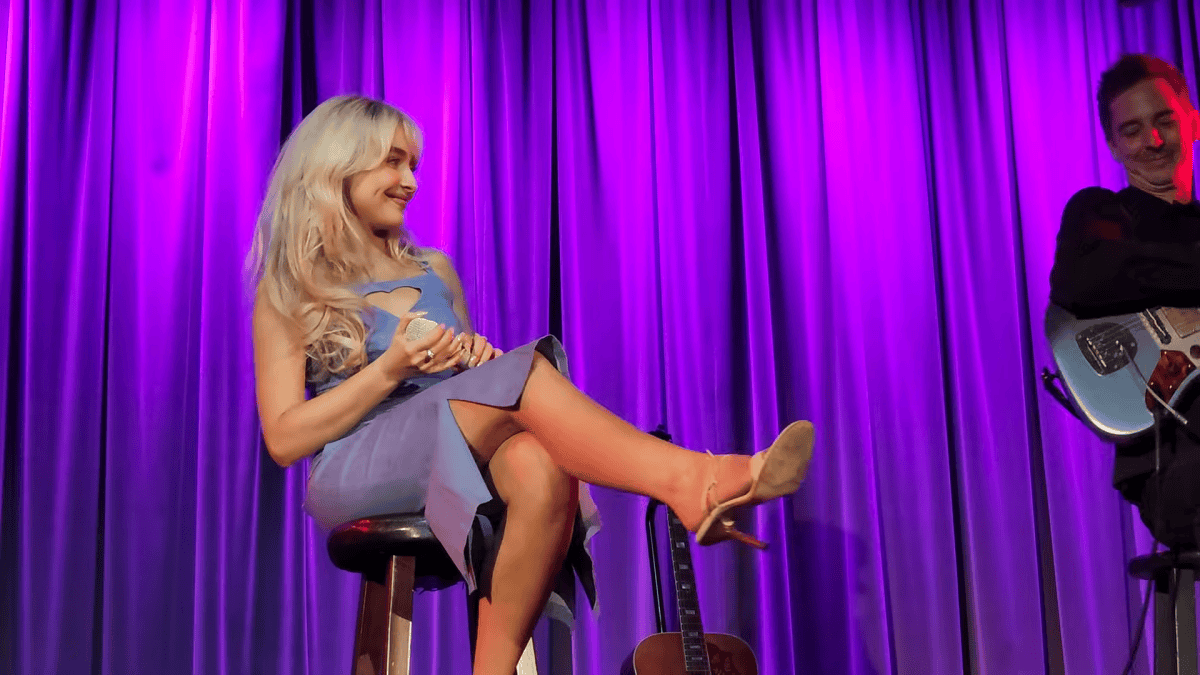
Some performances explode. Others glow. Sabrina Carpenter’s live version of “Espresso,” captured in this quiet, elegant setting, belongs to the second kind. There are no flashing screens, no choreography, no roaring crowd. Instead, there is a stool, a curtain, warm amber light, and a singer who knows exactly how to let stillness do the talking.
From the first frame, the mood is set. The soft draped backdrop feels like something from an old jazz lounge or a late-night television set, the kind of room where stories are whispered instead of shouted. The lighting wraps the stage in honey-colored warmth, giving everything a cinematic hush. This is not a pop spectacle. This is a moment.
Sabrina enters already seated, legs crossed, posture relaxed but precise. She isn’t trying to command the room with movement. She doesn’t need to. Her presence alone does the work. In a simple blue dress, with minimal styling and no distractions, she looks composed, calm, and quietly confident. It’s the kind of confidence that doesn’t announce itself. It simply exists.
When the first notes of “Espresso” arrive, the transformation is immediate. The song that usually sparkles with playful energy softens into something more intimate, almost conversational. The rhythm settles into a gentle groove, giving the lyrics space to breathe. Instead of bouncing off the walls, the melody seems to lean closer to the listener.

And then there’s her voice. Up close, without layers of production, Sabrina’s vocal control becomes the star. Each phrase lands with precision. Every breath is intentional. She doesn’t rush. She lets lines linger just long enough to feel personal, like she’s telling a story meant for only a few people in the room. The microphone placement keeps her voice warm and close, drawing the audience into a private world built entirely out of tone and timing.
What makes this performance especially striking is how little she moves. Seated, still, and centered, Sabrina turns restraint into charisma. A small tilt of the head, a subtle smile, a glance toward the guitarist at her side, these become her choreography. In a pop era defined by motion and spectacle, she proves something quietly powerful: sometimes stillness is the boldest choice of all.
The guitarist sits just off to the side, understated and supportive, offering soft textures that cradle the melody instead of competing with it. The arrangement leaves space everywhere, between notes, between lines, between breaths. That space becomes part of the performance. Silence isn’t empty here. It’s alive, shaping the mood and deepening the intimacy.
As “Espresso” unfolds in this setting, the song itself seems to change. What once felt playful and flirtatious becomes reflective, even slightly vulnerable. The lyrics take on new color. The rhythm becomes less about energy and more about atmosphere. It’s no longer just a catchy hit. It’s a late-night confession wrapped in melody.
This is where Sabrina Carpenter’s artistic maturity shines brightest.
She doesn’t rely on vocal acrobatics or dramatic gestures to make this moment land. Instead, she leans into control, phrasing, and emotional clarity. It’s the mark of a performer who understands not just how to sing, but how to shape a room. In this quiet setting, she bridges modern pop with old-school stagecraft, channeling a timeless performer’s instinct: let the song lead, and follow it honestly.
There’s something almost nostalgic about watching it. The curtains, the stool, the lighting, it all recalls a time when singers built careers in small rooms before stepping onto big stages. And here, even with global fame behind her, Sabrina chooses to return to that intimacy, reminding us where music often feels most real.
By the time the final lines fade, there’s a sense that something rare has just happened. Not a viral moment. Not a spectacle. But a genuine performance that lingers, like the aftertaste of strong coffee or the final scene of a favorite film.
In the end, this version of “Espresso” doesn’t aim to energize.
It aims to stay with you.
And it does, softly, gracefully, and long after the lights dim.