When the King Whispered His Regret: Elvis Presley’s Quiet Confession in “Always On My Mind”
On March 30, 1972, inside RCA Studio C in Hollywood, Elvis Presley sat down with a microphone, slipped on a pair of heavy studio headphones, and recorded what may be one of the most honest moments of his career. No rhinestone jumpsuit. No screaming crowd. No flashing lights. Just a man, a song, and a lifetime of things he wished he had said sooner.
The result was “Always On My Mind,” and more than fifty years later, it still feels like we’re eavesdropping on something deeply private.
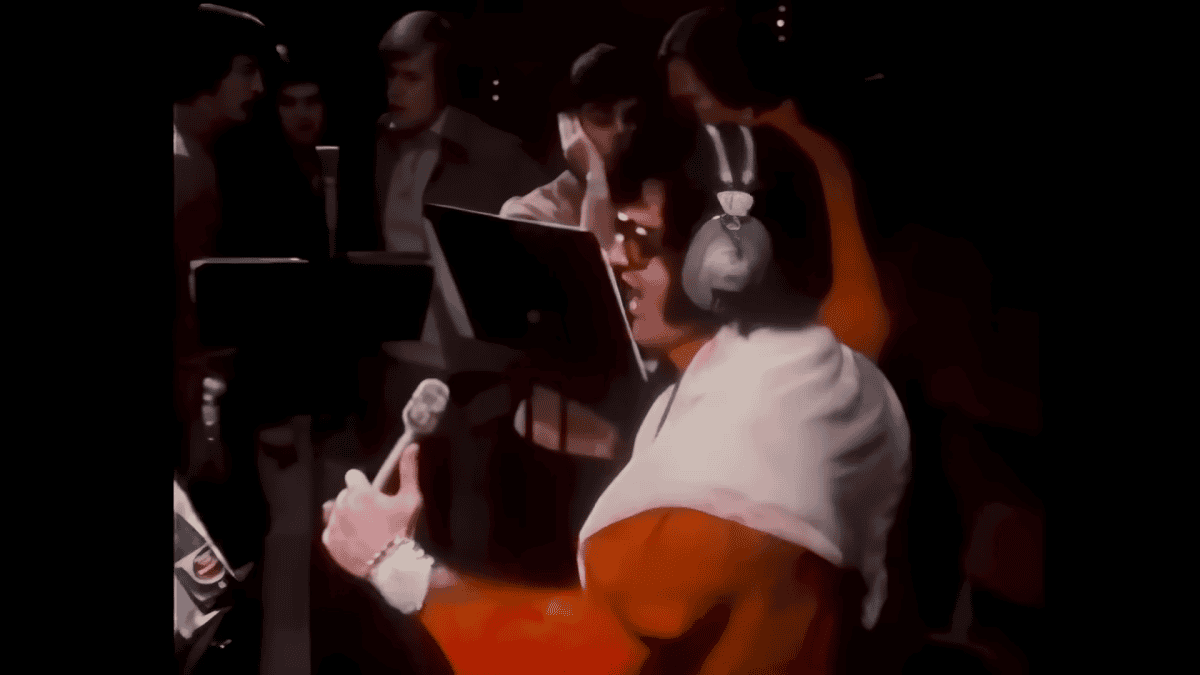
The image from that session tells the story before a single note is sung. Elvis sits quietly, wrapped in a burnt-orange shirt and a white scarf, sunglasses hiding eyes that look tired even behind the tint. He holds the microphone close, as if afraid to let the words escape too loudly. Behind him, musicians and backing singers stand still, watching through the soft glow of studio lights. Everyone in the room seems to understand this isn’t just another take. This is something fragile.
By early 1972, Elvis’s life was standing at a crossroads. His marriage to Priscilla was breaking apart. Fame still followed him everywhere, but the personal joy that once fueled it was slipping through his fingers. The King was still selling records, still packing arenas, but inside, there were cracks that no applause could cover.
“Always On My Mind” is built around regret, the kind that arrives too late, when love has already drifted out of reach. Lines like “I guess I never told you I’m so happy that you’re mine” and “If I made you feel second best, girl, I’m so sorry I was blind” don’t sound like lyrics in this version. They sound like thoughts that have been sitting quietly in someone’s chest for a long time.
Instead, he sings softly, carefully, as if the words might shatter if handled too roughly. There’s a restraint in his voice that feels almost painful, a man choosing honesty over spectacle. Every phrase lands gently, and in that gentleness, you hear the weight of what he’s admitting.
At times, his voice sounds tired. Not weak, just human. Like someone who has lived fast, loved deeply, and suddenly realized how many small moments slipped past unnoticed. The famous power is still there, but it’s wrapped in vulnerability, and that’s what makes this performance unforgettable.
The setting only deepens the emotion.
RCA Studio C becomes something like a confession booth. Elvis is isolated by his headphones, sealed inside his own world while the band waits quietly behind him. No one interrupts. No one rushes him. The arrangement stays minimal, giving his voice all the space it needs. It feels less like a recording session and more like a letter being read out loud for the first time.
What few listeners realized at the time is how closely this song would come to mirror his life. Within months, Elvis and Priscilla would officially divorce. In the years that followed, “Always On My Mind” would become one of the defining ballads of his later career, a song fans would forever link to heartbreak, reflection, and the softer side of a man often remembered only for his swagger.
Ironically, Elvis recorded this version before Willie Nelson made the song famous. But there’s something about Elvis’s take that still feels unmatched. Nelson’s version is tender. Elvis’s version feels haunted.
It’s not hard to imagine that he was thinking of Priscilla as he sang. Or maybe he was thinking of all the people he had loved and lost along the way. Or maybe, hardest of all, he was thinking about himself.
In a career filled with legendary stage moments, this quiet recording stands apart. Here, the King is not larger than life. He’s just a man admitting that love sometimes slips through your hands while you’re busy chasing the world.
And when the final note fades, there’s a silence that feels heavier than applause. For a few minutes in that studio, Elvis Presley stopped being a legend and became someone we all recognize. And somehow, in whispering his regret into a microphone, he gave the world one of the most tender performances it would ever hear.